


US STUDIES: 2024 - 2026
Across three bronchoscopic navigation platforms studied in the U.S. between 2024 and 2026, the Galaxy System delivered the highest and most consistent diagnostic yield under the American Thoracic Society's strict definition.
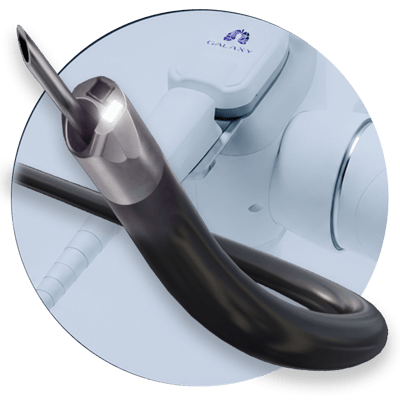
The Galaxy System, through its 3D visualization and tool targeting, uniquely enables physicians to correct for CT-to-body and tool-tissue divergence in real-time. These real-time adjustments help physicians to deliver best-in-class diagnostic yields while fitting into hospitals' current imaging infrastructure and workflows.
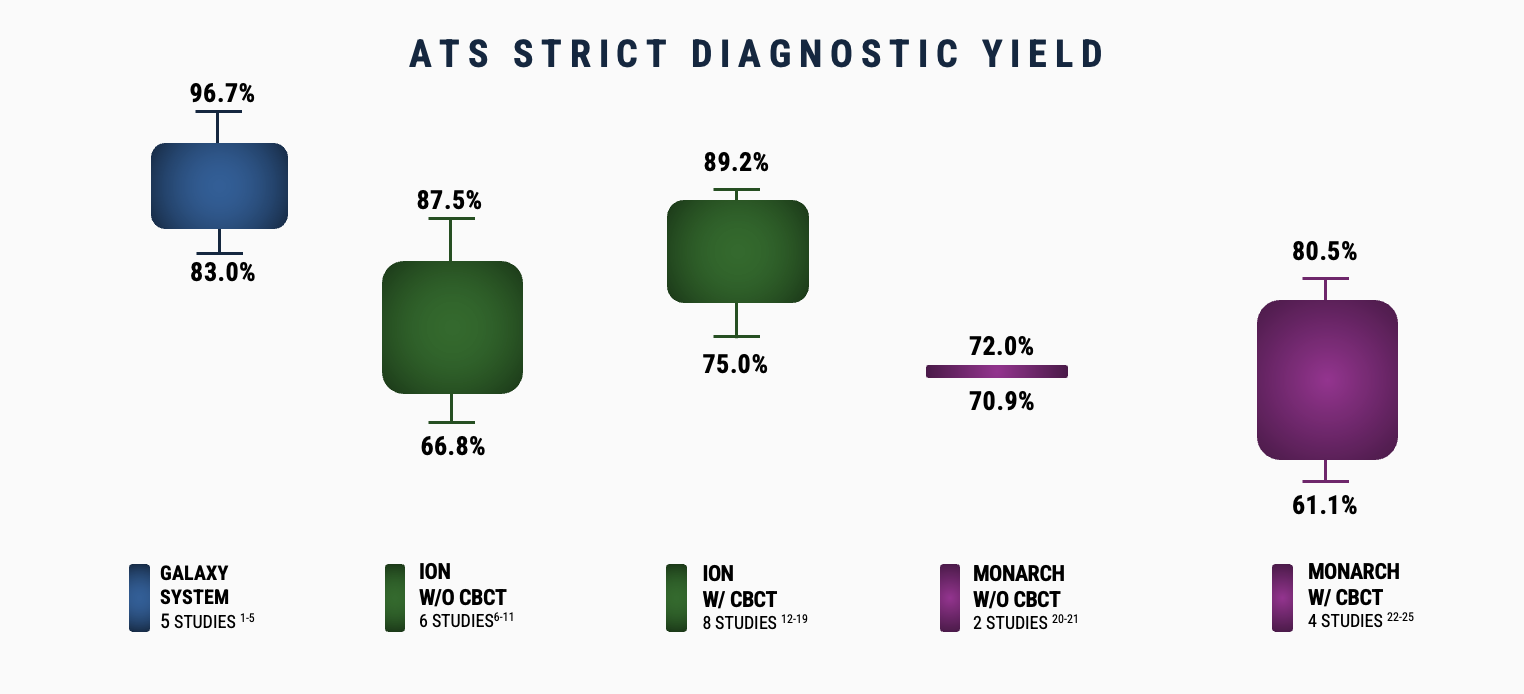
One outlier study from the Galaxy System and Ion w/o CBCT removed (Galaxy: USC 68% DY | Ion w/o CBCT: Bashour 29.9% DY)
MATCH 2:
What Is Achievable in Experienced Hands
Amit Mahajan, MD+, Krish Bhadra, MD++, Johanna Cortes, NP++, Kevin Duong, MD+
+. Inova, Fairfax, VA, ++. CHI Memorial, Chattanooga, TN
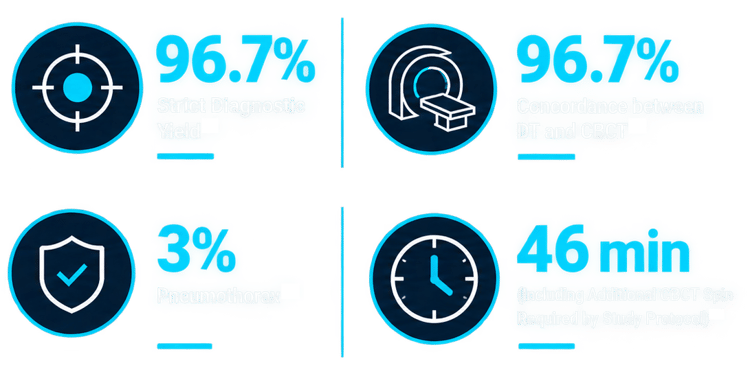
In a prospective multi-center study, experienced Galaxy operators achieved a 96.7% strict diagnostic yield, with 96.7% concordance between embedded digital tomosynthesis and CBCT confirmation. MATCH 2 demonstrates what is achievable when experienced operators use the Galaxy System within an optimized imaging workflow.
Initial Experience:
A novel robotic bronchoscopy system with Integrated Tool-in-Leson Imaging with the Galaxy System
Joseph Cicenia*, Grant Senyei*, Sonali Sethi*, Colin Gillespie* and Christopher DeFelice**
*Cleveland Clinic, Cleveland, OH, **VA Medical Center,

Across 100 consecutive cases and 116 nodules averaging only 12.9 mm, the Galaxy System achieved a 90% strict diagnostic yield and 98% tool-in-lesion. This experience moves beyond controlled feasibility and demonstrates consistent targeting and diagnostic performance in a demanding, everyday clinical population that included very small lesions
Early Commercial Experience:
Independent Replication of Safety and Efficacy Findings
Matthew Federbush, Michael Murn, Abhinav Agrawal
Northwell Health, New Hyde Park, New York

Northwell Health’s early single-center experience included 60 patients and 67 nodules, with an average lesion size of 21.8 mm and an 88% strict diagnostic yield. This study provides an additional institutional assessment of the Galaxy System’s safety and diagnostic performance, demonstrating that strong early results were reproducible beyond the first-in-human and original early-adopter sites.
Beyond the Scope:
Clinical and Economic Viability in the Community
Roshen Mathew, MD
WVU Camden Clark Medical Center

Seventy consecutive community-hospital cases achieved an 89% strict diagnostic yield. Procedures were financially viable in both the endoscopy suite and the operating room, with cost-benefit ratios of 1.5 versus 1.1. The study demonstrates that advanced robotic bronchoscopy can be both clinically effective and operationally sustainable in a community setting.
Large-Scale Clinical Experience:
Joseph C. Cicenia, Duy K. Duong, Douglas Kyle K. Hogarth, Sonali Sethi, Colin T. Gillespie, Amit K. Mahajan

Across 190 patients and 223 nodules averaging 15.1 mm, the largest early clinical dataset presented here reported an 83% strict diagnostic yield. Its distinctive contribution is demonstrating performance at scale and showing how precise targeting and tool-in-lesion imaging can provide added confidence
FRONTIER:
First-in-Human Performance With Rapid Adoption
Tajalli Saghaiea, Jonathan Williamsona, Martin Philipsa, Dona Kafilia, Sarika Sundara, D. Kyle Hogarthb and Alvin Inga
a. Faculty of Medicine, Health and Human Sciences, Macquarie University, NSW, Australia. b.University of Chicago, Chicago, IL
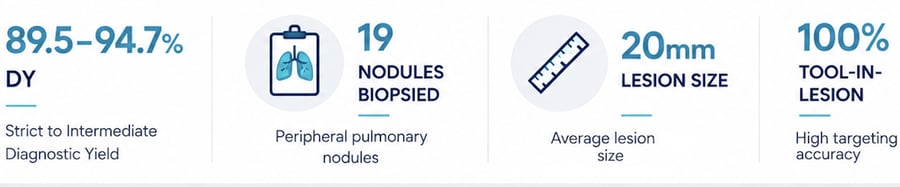
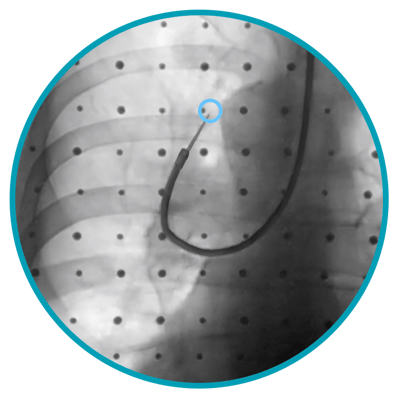
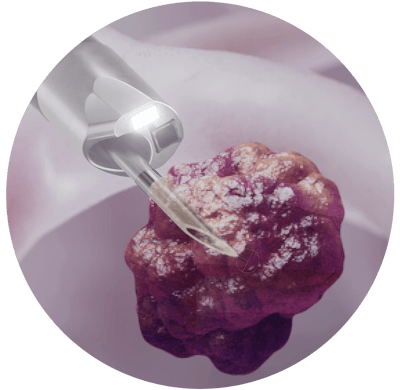
FRONTIER was the first-in-human evaluation of the Galaxy System. Although the Australian investigators had no previous robotic bronchoscopy experience, they successfully reached every target, confirmed tool-in-lesion in every case, and achieved an 89.5% strict to 94.7% intermediate diagnostic yield. These outcomes illustrate how image-embedded robotics and an integrated workflow can simplify procedural decision-making, improve efficiency, and potentially reduce cognitive burden
SEE THE GALAXY SYSTEM IN ACTION
References
-
Respiratory Medicine Journal. Robotic-Assisted Bronchoscopy Study. 2026. resmedjournal.com/article/S0954-6111(26)00061-2/abstract
-
CHEST Journal. Bronchoscopy Outcomes Data. 2025. journal.chestnet.org/article/S0012-3692(25)05485-6/fulltext
-
CHEST Journal. Bronchoscopy Comparative Analysis. 2024. journal.chestnet.org/article/S0012-3692(24)03940-0/fulltext
-
Journal of Bronchology & Interventional Pulmonology. 2024 Abstracts — Final. journals.lww.com/bronchology/Documents/2024%20Abstracts%20-%20Final.pdf
-
Journal of Bronchology & Interventional Pulmonology. 2024 Abstracts — Final (supplemental). journals.lww.com/bronchology/Documents/2024%20Abstracts%20-%20Final.pdf
-
Journal of Bronchology & Interventional Pulmonology. Robotic Bronchoscopy Review. 2025. journals.lww.com/bronchology/pages/articleviewer.aspx?year=2025&issue=10010&article=00003&type=Fulltext
-
Mayo Clinic Proceedings. Bronchoscopy Clinical Outcomes. 2025. mayoclinicproceedings.org/article/S0025-6196(25)11663O-5/abstract
-
Annals of the American Thoracic Society. Navigation Bronchoscopy Advance Article. 2025. academic.oup.com/annalsats/advance-article/doi/10.1093/annalsats/aaoaq049/8503851
-
Respiratory Medicine Journal. Bronchoscopy Cost-Effectiveness Study. 2026. resmedjournal.com/article/S0954-6111(26)00034-X/abstract
-
Journal of Bronchology & Interventional Pulmonology. 2025 Abstracts. journals.lww.com/bronchology/Documents/2025%20Abstract.pdf
-
American Journal of Respiratory and Critical Care Medicine. Supplement 1. 2025. academic.oup.com/ajrccm/article/211/Supplement_1/A22720/8334122
-
Mayo Clinic Proceedings. Bronchoscopy Clinical Outcomes (supplemental). 2025. mayoclinicproceedings.org/article/S0025-6196(25)11663O-5/abstract
-
Respiratory Medicine Journal. Bronchoscopy Cost-Effectiveness Study (supplemental). 2026. resmedjournal.com/article/S0954-6111(26)00034-X/abstract
-
Thorax BMJ. Bronchoscopy Outcomes. 2026;81(3):267. thorax.bmj.com/content/81/3/267.long
-
PubMed Central. PMC12898066. pmc.ncbi.nlm.nih.gov/articles/PMC12898066/
-
Journal of Bronchology & Interventional Pulmonology. 2025 Abstracts (supplemental). journals.lww.com/bronchology/Documents/2025%20Abstract.pdf
-
PubMed Central. PMC11494579. pmc.ncbi.nlm.nih.gov/articles/PMC11494579/
-
Karger — Respiration. Shape-Sensing Robotic-Assisted Bronchoscopy Study. karger.com/res/article-abstract/doi/10.1159/000397/906406/Shape-Sensing-Robotic-Assisted-Bronchoscopy-in-the
-
Thorax BMJ. Bronchoscopy Navigation Study. 2025;80(3):150. thorax.bmj.com/content/80/3/150.long
-
PubMed Central. PMC12898066 (supplemental reference). pmc.ncbi.nlm.nih.gov/articles/PMC12898066/
-
Lung Cancer Journal. Bronchoscopy Navigation Study. 2026. lungcancerjournal.info/article/S0169-5002(26)00005-X/abstract
-
Lung Cancer Journal. Bronchoscopy Navigation Study. 2026. lungcancerjournal.info/article/S0169-5002(26)00005-X/abstract
-
ScienceDirect. Bronchoscopy Comparative Study. 2025. sciencedirect.com/science/article/pii/S0012369225005483
-
Journal of Bronchology & Interventional Pulmonology. Robotic Bronchoscopy Review (supplemental). 2025. journals.lww.com/bronchology/pages/articleviewer.aspx?year=2025&issue=10010&article=00003&type=Fulltext
-
American Journal of Respiratory and Critical Care Medicine. Supplement 1. 2025. academic.oup.com/ajrccm/article/211/Supplement_1/A22734/8333762
-
Mahajan AK, Duong DK, Cortes J, Bhadra K. The MATCH 2 study: Robotic assisted bronchoscopy with integrated imaging with assessment of digital tomosynthesis (DT) and augmented fluoroscopy (AF): Three-dimensional accuracy as confirmed by cone beam computed tomography (CBCT). Respir Med. 2026;253.